
World's First Square Card Tactical TCG
A fusion of the classic tabletop card game and the tactical grid board game. Built for players who want position to matter as much as the draw.
Why Square? Why Grid?
We broke the standard trading card mold to deliver a faster, more cerebral tabletop experience.
Perfect Square Design
Standard cards take up too much vertical space. Our custom 63.5mm x 63.5mm square cards are engineered to fit perfectly in a compact tactical grid, letting you view the entire battlefield at a glance.
Positioning is Power
In Faction TCG, your cards aren't just sitting in a static row. They move, flank, block, and retreat across a dynamic 5x6 battlefield. Protect your Leader, capture strategic lanes, and lock down territory.
Melee & Ranged Combat
Deploy swift Melee units to crash the front lines, or position Ranged snipers in the backline to lock down entire lanes. Every unit's combat type completely dictates your tactical board control.
Master the 5x6 Tactical Grid
Click a unit type below, then hover or click cells on the holographic grid to see movement capabilities and attack ranges in action.
Melee Tactical Intel:
- Movement: 1 space in any cardinal direction (up, down, left, right).
- Attack Range: Can only attack adjacent units (1 space away).
- Tactical Use: Heavy tanks and high-impact fighters. Deploy them to body-block enemy units and shield your Leader.
Ranged Tactical Intel:
- Movement: 1 space in any cardinal direction.
- Attack Range: Can strike units up to 5 spaces away, but only in straight vertical or horizontal lanes.
- Tactical Use: Snipers and backline supports. Keep them safe in the back rows to rain damage down the lanes.
How to Play & Dominate
Master the three structural pillars of a Faction TCG matchup.
Game Start & Hidden Setup
Matches begin with high tension. A coin flip determines who secures priority, then the psychological warfare immediately kicks off with face-down placements.
- Opening Hand: Draw six cards. If not one of them is a Unit, shuffle them back and draw six new ones.
- Prize Cards: Set the top five cards of your deck aside, face down. These are your Prize Cards, which you win by defeating enemy units.
- Leader Placement: Players place their primary Leader unit Face Down in the centre of their Bottom Row, the row nearest them (Cell C1/C6).
- Pre-Game Deployment: Deploy extra units from your starting hand to the Bottom Row, completely Face Down to hide your opening formation.
- The Reveal: Once both players lock in their setup, all face-down cards are simultaneously flipped over. The battle begins!
Draw
Draw one card from your deck.
Deploy
Play as many Tactics as you like, up to one Order, and one Charge onto a unit. Place new units in your Bottom Row, up to five on the field.
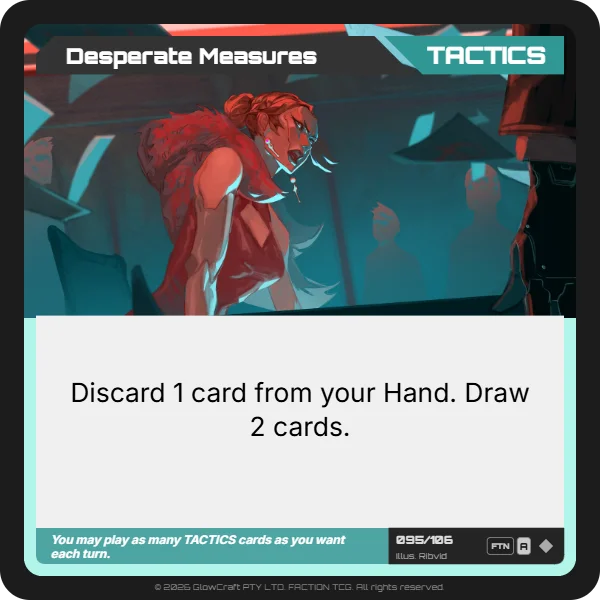
- Tactics: As many as you can play. Heals, traps, draws, and more.
- Orders: One per turn. Search your deck, extend your movement, or even enhance a unit.
- Charge: One per turn onto any unit you control. A Charge is not a card and nothing is discarded for it; it is a counter you spend to pay an attack's cost. Gear is the separate system, and it equips only to your Leader.
- Units: Place new units in your Bottom Row, up to five on the field.
Attack
Entering the Attack Phase closes exactly one thing: you can no longer deploy Units. Tactics, Orders and a Charge all still work. Move one unit one square if you wish, then take one of three actions. Each one ends your turn.
- Unit Movement: Move exactly one unit one square in any cardinal direction to outflank or block. This is optional, and it does not end your turn.
- Declare Attack: Select one unit to attack an enemy card in range. Resolving this attack immediately ends your turn.
- Triage: Instead of attacking, clear BLEEDING from one of your own units. This is the only way to remove it - no card cures it - and a DEAFENED unit cannot be Triaged.
- Leader Change: Instead of attacking, promote a unit already on the field to be your new Leader. The outgoing Leader's Gear is discarded; exhausted Gear moves across.
To prevent overwhelming advantages, the player going first gives up most of their opening turn: no attack, no Leader Change, no Order, and no move. They can still draw, deploy units, attach a Charge and play Tactics. Winning the initiative duel does not ensure outright victory.
Check-up
Maintain the battlefield before control passes to the next player.
- Status Effects: Units that are BLEEDING lose 10 HP.
- Knockouts: Any unit on 0 HP is defeated and removed from play.
- Conditions do not clear here: each one lifts at the start of the turn of whoever applied it, not at the end of yours. BLEEDING never lifts on its own at all.
Prizes are claimed the moment they are earned, interrupting whoever's turn it is. You do not wait until your own turn to collect, the way most card games make you.
Claim all 5 Prize Cards to win the match!
Three ways to win
Most matches are decided on Prize Cards, but they are not the only way a game ends.
Domination
Claim all five of your Prize Cards. You take one every time you knock out an enemy unit, so this is the route most games take.
Depletion
Your opponent has to draw from an empty deck. With a 50 card deck and one draw a turn, decking out is a real clock in a long game.
No Leader
Your opponent loses their Leader and has no unit left to promote. Losing a Leader is survivable; losing the last one is not.
Four card types in a deck
FACTION runs with a single "Charge" attachment per turn, so decks aren't bogged down with resource cards.
Units
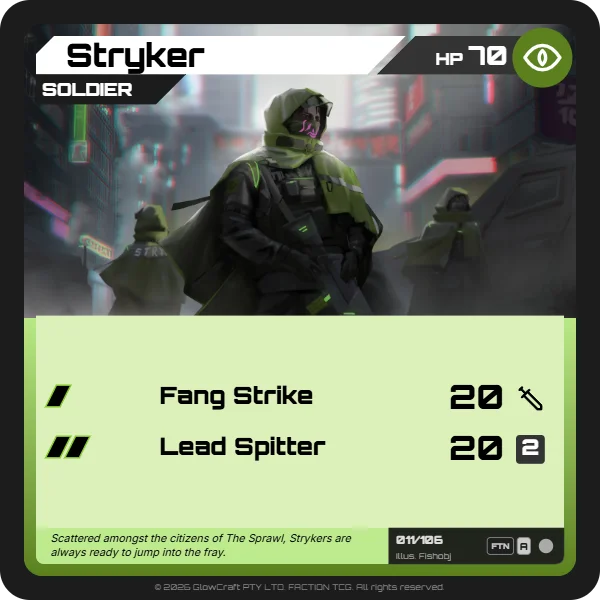
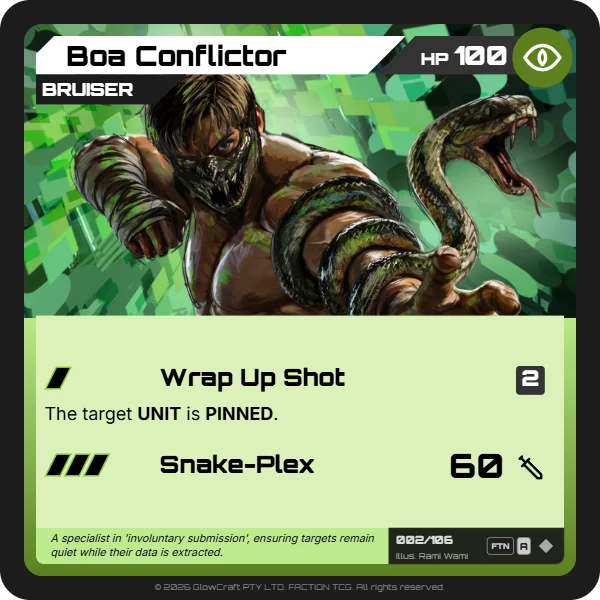
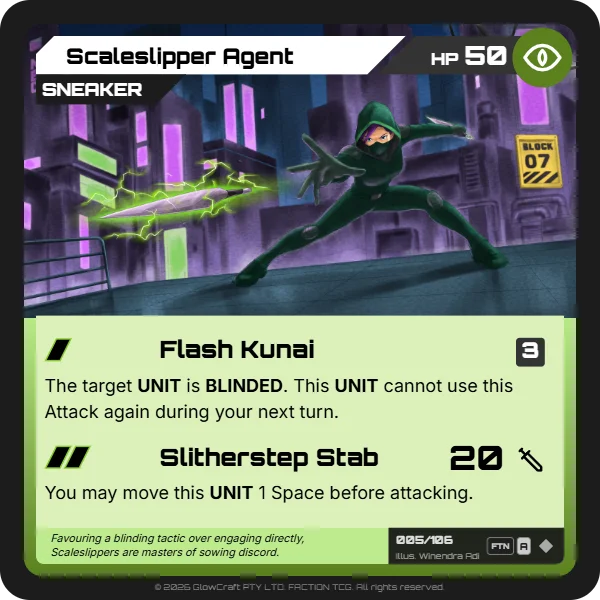
Your fighters on the battlefield, each with HP, attacks and abilities. One of them is your Leader.
Tactics
Quick plays, as many per turn as you can play. Heals, traps, draws, and more.
Orders
More substantial commands, only one a turn. Search your deck, extend your movement, or even enhance a unit.
Gear
Bolt extra capabilities onto your Leader: bleed enemies as you strike, shrug off incoming damage, or push your way down the battlefield.
Leaders and Gear
- Being the Leader grants no powers of its own. A Leader is simply the only unit that can equip Gear. The Gear is where the power sits.
- One Gear per Leader, and most Gear equips only to a Leader of its own faction. Gear adds HP, movement, Range or BLEEDING on your attacks.
- Lose your Leader and you must promote another unit at the start of your turn. With no unit left to promote, you are out of the game.
- A Leader Change discards the Gear on the incoming Leader, unless that Gear is exhausted.
Reading an attack
- AP cost. One pip per point of Charge the attack needs. Pips fill in as the unit is charged.
- Melee. The dagger means range 1 - the attack only reaches an adjacent square.
- 3 Ranged. A number is the reach in squares, straight down a lane. Snipers print 2-5.
Five ways to be shut down
Plenty of attacks and cards apply conditions rather than just dealing damage. Hover any term for its full rules text.
- PINNED - stuck in place.
- DAZED - can't attack.
- BLINDED - no ranged attacks; melee still works.
- DEAFENED - no Order, Tactic or ability can target it, from either player.
- BLEEDING - loses HP every Check-up until treated.